Friday, 27 June 2025

Adventures in Devon - Berry Head and Braunton Burrows - June 2025

 A few days after returning to Cornwall from Kent, I ventured back East to South Devon to visit Berry Head. Whilst in Kent, I had missed the Devon Botany field trip there, so I hoped to find at least some of the rarities found on this limestone outcrop on my own.

  The first plant of note was White Rock-rose and it was quite easy to find as it was abundant wherever there were boulders and short turf. However, the majority of plants were clearly in seed (see 3rd photo below) and I had to hunt around a bit to find some flowering. It's a beautiful flower and large enough to easily find.

Helianthemum apenninum 


Small Restharrow is another Berry Head rarity. Its flowers looks the same as Common Restharrow, however, it is an annual plant and is very small as a result. To differentiate from Common and Spiny Restharrow, look at the leaves. They are widest near the tip in Small Restharrow and widest in the middle in the other two species. Add in their tiny stature and that they lack a creeping habit, and they become easier to spot. They were widespread over the headland, sometimes growing with Common Restharrow too. I'm surprised they do not hybridise, but perhaps one being an annual means they are not genetically compatible.

Ononis reclinata


I was very surprised to find Autumn Squill flowering in large numbers on the cliff slopes (and one in the cafe lawn!). They're a good 2-3 weeks early, in fact, so early that I could still find Spring Squill in seed nearby.

Scilla autumnalis 


Honewort is another rare plant found here. Unfortunately, they had all burnt off in the heat and drought of the past week and I could only find a single plant in seed with withered leaves. In this area were records of Small Hare's-ear too, but I couldn't find any, despite extensive searching.

Trinia glauca 


Narrow-leaved Everlasting Pea is a native species, usually coastal and with dull pink flowers. As the name suggests the leaves are narrow and around six times longer than wide. That is nicely illustrated in the photo below.
 
Lathyrus sylvestris 


Lesser Meadow-rue is a species that I had seen a few times along the lanes in Cornwall, but always as a garden escape. At Berry Head, it was plentiful as a native plant in slightly scrubby areas away from the clifftops. It's a spindly, thin plant, so rather difficult to get a photo of the whole plant, as the stems merge into background vegetation and appear invisible. The flowers lack petals, but the delicate pink stems and bright yellow anthers make up for that.
 
Thalictrum minus 


A patch of Rough Clover near the cafe. These were very small, no doubt drought stricken plants.

Trifolium scabrum
 

The end of my walk took me down into the quarry area of Berry Head where I found two plants of Pale St. John's-wort, unfortunately still in bud, but clearly different to the other Hypericums present.
 
Hypericum montanum


 Finally, in a short grassy clearing in the quarry were around 50 Southern Marsh Orchids in prime condition. Pyramidal Orchids were plentiful over much of the headland too.
 
Dactylorhiza praetermissa


A few days later, I went to Braunton Burrows in North Devon, where I was kindly guided by the VCR for North Devon, Bob Kirby. One of the key species I had hoped to see was Water Germander, but it was only flowering in the northern area of the venue and we had chosen the south. We looked hard, in known places, but couldn't find any in flower. So finding it will be a good reason to go back next year for another visit.
 
However we did find many wonderful plants, including some new species for me. Here's some of them.
 
Close to the car park growing on the edge of a sandy path was a lot of White Horehound, a rare and declining species.
 
Marrubium vulgare


 Nearby, on the beach was Sea Stock, a new species for me, and also quite rare.
 
Matthiola sinuata


A few Frosted Orache were nearby, with one in full "flower", though they lack any petals.
 
Atriplex laciniata
 

 Soapwort on the beach.
 
Saponaria officinalis
 

 The last plant from the beach area was Prickly Saltwort. A spiny annual plant with tiny flowers that lack petals.
 
Salsola kali
 
  
We then headed into the vegetated dunes and it wasn't long before we came across drifts of Sand Toadflax. It was first recorded here in 1971, but it's not a native plant. The military often do training here and perhaps the seeds of this plant came in on military equipment or boots. It was an interesting plant though with toadflax like blooms atop a slender stem; the plants sometimes in tight clumps, sometimes singly.
 
Linaria arenaria


We then found Sticky Storksbill and took some time to determine that it was indeed that and not just a sand covered Common Storksbill. Sticky, as its name suggests has glands that sand sticks to which doesn't blow away if you blow on the plants leaves; in the seeds there is a basal pit with lines of flat hairs laying horizontally along the edge of the pit and finally, there is no groove outside of these hairs. All these things together show this to be Sticky Storksbill. You have to pull back the sepals to see these details. I've probably seen this before and failed to recognise it as I didn't know for sure what to look for; so many thanks to Bob for showing me.
 
Erodium lebelii


Marsh Helleborines were plentiful here, as were Southern Marsh Orchids. It was great to see so many given that it's a rare and declining species over much of the UK.
 
Epipactis palustris 


It's unusual for this species to have well developed stem leaves on show. At most venues, the plants are small and the leaves wither quickly, so it was nice to see some giant specimens with plenty of leaves too.
 

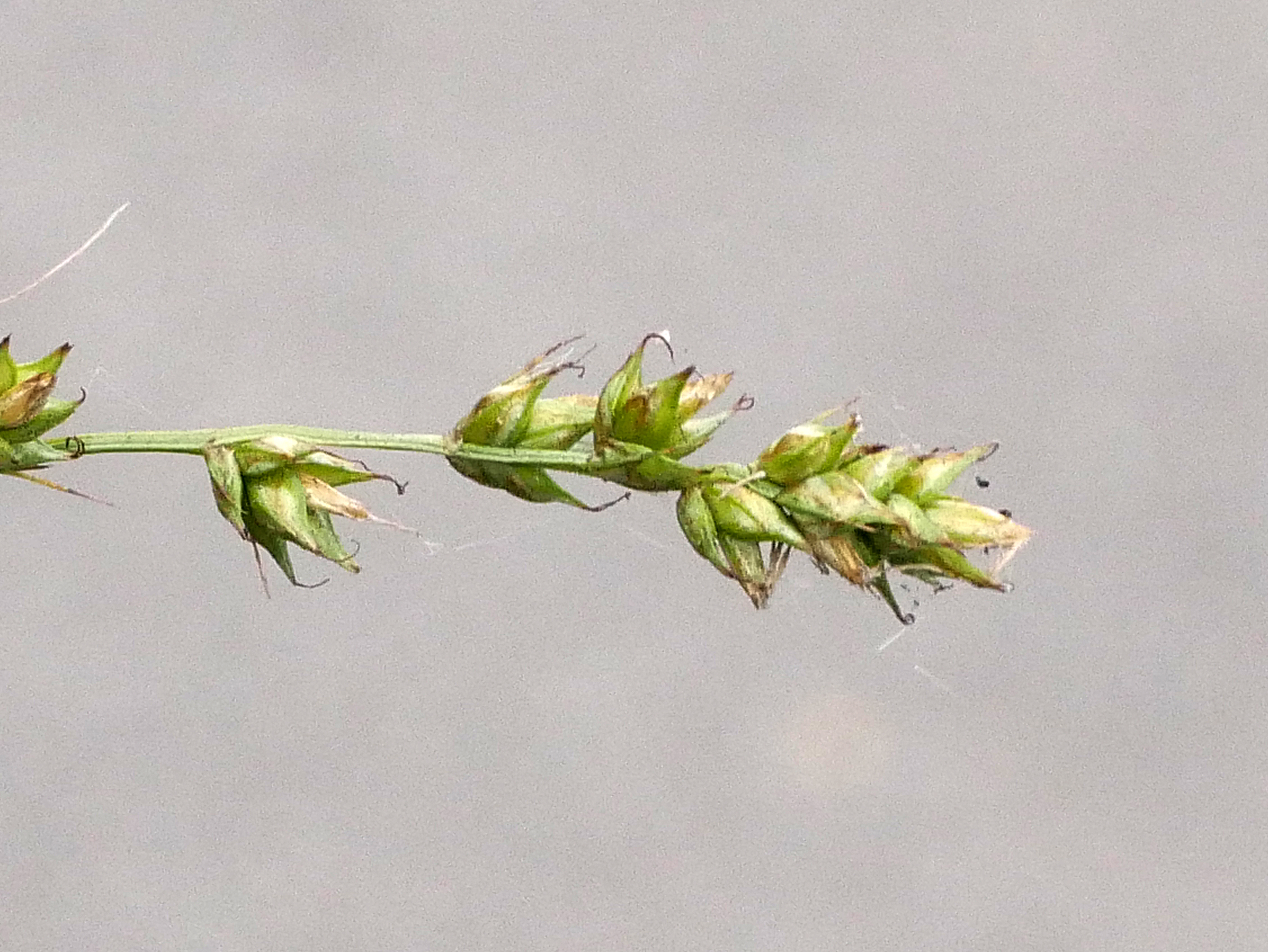
 Dotted around the dunes were lots of small sedges with tiny pineapple like fruits. A new species for me, Small-fruited Yellow Sedge. Unlike the floppy leaves of Common Yellow Sedge, these had stiff, short leaves form a central rosette.
 
Carex viridula


Another small plant on the dunes was Knotted Pearlwort which was plentiful in places. So called, as from a distance, the leaves look like knots up the stem.
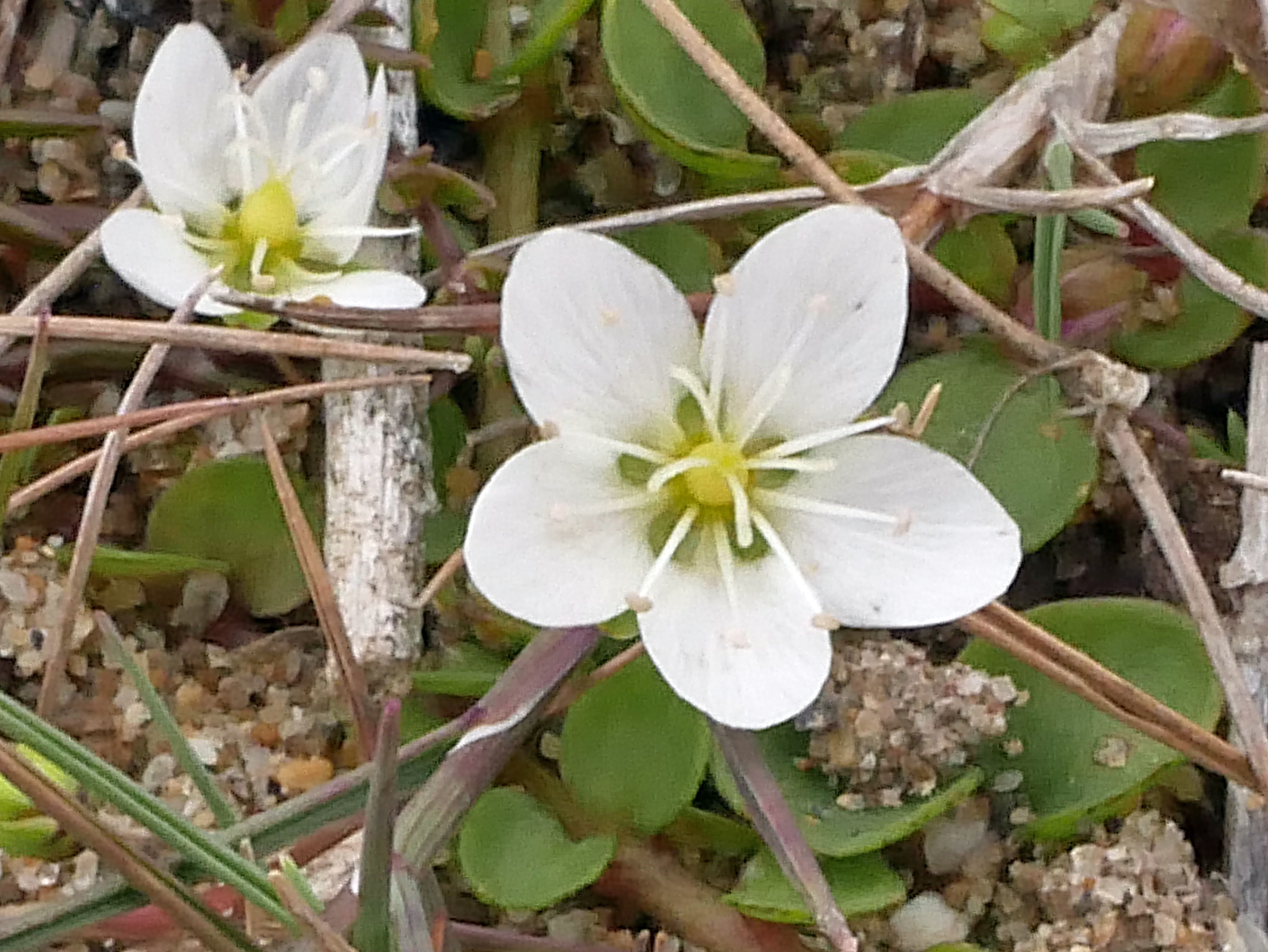
 
Sagina nodosa


 Often seen was another new species, Round-headed Club-rush, a peculiar looking rush with round fruits poking out of a central stem.
 
Scirpoides holoschoenus 


 Near one dune slack I found some Sea Milkwort in flower which was an odd find given that at that point we were over 1km from the sea. It shows that the dunes still hold some salinity.
 
Lysimachia maritima
 
  
In one of the damper areas were some Skullcap plants with their intense blue flowers. I haven't seen this plant for quite a few years, so it was good to see it again.
 
Scutellaria galericulata 


Nearby was Pink Water Speedwell.
 
Veronica catenata 
 

 The loveliest sight there had to be literally hundreds of Dune Pansies growing over a large dune slope. Beautiful delicate little yellow and white flowers, interspersed with other species was a delight to see. I'd only seen these before at Newborough Warren in Anglesey, several years ago, so it was a pleasant surprise to see so many in one place this day.
 
Viola tricolor subsp curtsii


Of course, I saw many other species there too; it's a special place for sure, as is Berry Head in the south. I will return next year to find the species that eluded me this time and hopefully other surprises too.
 Every county has a special venue or two for wildflowers, seek them out and take a visit, you won't be disappointed.
 
Take care
Dave 


Saturday, 7 June 2025

The Lizard Heathlands - 1st June 2025

 Of late, I have been writing a blog for each month, but some trips are so botanically rich that it would make the blog way too long if included in the general finds for the month. So, here is a single trip blog to the area of heathland from Goonhilly to Coverack.


 On arrival, I donned welly boots, as last time I had been here in June, it was too boggy and wet for walking boots. However, it soon became apparent how bad the recent drought had been, as the heathland was about 95% dried out. In some of the remaining boggy areas, young Round-leaved Sundews were coming up. 

Drosera rotundifolia 


 I got down low to get a photo of an individual leaf, showing the sticky blobs which are like glue and trap insects that land on them. The blobs then fold over into the centre of the leaf and the insect gets digested. Bogs are so nutrient poor that many carnivorous plants live in them.


Nearby were some Early Marsh Orchids. There's usually two subspecies here, a dark pink form and a white to flesh coloured flower form. Unfortunately, the flesh coloured flower (subsp incarnata) hasn't flowered this year, or has delayed flowering perhaps, so remained unseen by me.

Here's the darker form, which was reasonably common here. Early Marsh can easily be separated from Southern Marsh by it having loops and not dots on the lower petals, and it having lower petals with somewhat folded down sides.

Dactylorhiza incarnata subsp. pulchella


 In this boggy area were at least 100 plants of Common Butterwort, the only place in Cornwall where this plant can be found, though it is more common further north in the UK. 

Pinguicula vulgaris


This plant traps insects with sticky leaves that fold inwards to digest the insects.


It's close relative, Pale Butterwort was nearby, but in much smaller numbers. This species is found in many of Cornwall's bogs. It traps insects in the same way as Common Butterwort does, but is much smaller overall with pale, almost white leaves.

 Pinguicula lusitanica


The heathlands are full of various species of Ericaceous plants, such as Cornish Heath, Bell Heather, Heather and Cross leaved heath, the latter just starting to flower. Rarely, you can find a white flowered form too. As the name suggests, there are four leaves arising out of the stem in a more or less square pattern; Bell Heather only has three leaves. Also, the plants look greyish green from the large amount of tiny hairs on the leaves, whereas, Bell Heather is simply green.
 
Erica tetralix
 

 I try to photograph insects when I can too, but my days of chasing butterflies to get a photo of them are long gone. However, a few insects still oblige by staying put while I fiddle around with my camera, like this Green Dock Beetle. The enlarged abdomen shows this to be a female full of eggs. You can usually find them on Dock plants, like I did here.
 
 Gastrophysa viridula
 

 A big surprise was a Green Hairstreak landing right next to me; I've never seen one in Cornwall before, though there used to be plenty in Kent.
 
Callophrys rubi


Great Burnet is common on the heathland, but only one had its first flower coming out.
 
Sanguisorba officinalis
 

 In the drier parts of the heath, I found a few scattered Heath Fragrant Orchids. These are much smaller than Marsh and Chalk Fragrants and each species smells a bit different too.
 
Gymnadenia borealis


 By my car in a lay-by, I noticed that many Meadowsweet plants had a bright orange fungus on them, so I took some photos and found them to be Meadowsweet Rust Fungus; it's common where there are large numbers of Meadowsweet plants. Many species of plants have their own rust fungus associated with them.
  
Triphragmium ulmariae 
 
  
I then drove about a mile to a different part of the heathland which had a variety of habitats, thus meaning I could find more plants of interest. The gravel car park was a good place to start with several nice plants there. First was a single Fairy Flax plant in flower. I'd not seen these in this area before, but apparently they are often recorded on The Lizard. They're very difficult to photograph as thet are at most 5cm tall with tiny flower stems that move about in the slightest breeze, and this day the wind was gusty, so below was the best I could do.
 
Linum catharticum 
 

 Nearby was a patch of Trailing St. John's-wort with another patch of plants down a farm track. Don't be fooled by the photo, the flowers are not large, being about 1cm across.
 
Hypericum humifusum


I came upon a small pond which still had some water in it. The pond was dominated by Bottle Sedge, a species I had not knowingly seen before. I find the bigger sedges much easier to key out than teeny weeny specimens!
 
Carex rostrata


On all the heathlands, there are plenty of Heath Spotted Orchids, which favour the dry, acidic soils found there. It's very hard not to stop and photograph all of them as they are a lovely little plant here, reaching around 10-15cm in height. In southeast England though, they can grow to about 45cm tall. There's a bonus Flea Sedge (Carex pilucaris) in the second photo that I deliberately left there to show what grows with the orchids. Many photographers "garden" around the subject and make the background fuzzy, I prefer not to, at least not all the time.
 
Dactylorhiza maculata subsp ericetorum


Bristle Club-Rush likes it damp, but the drought meant that most are high and dry, but they still seemed to be doing fine. The plant below looks healthy enough and was in flower. 
 
Isolepis setacea
 
 
There are two species of Isolepis, the one featured, which has bracts overtopping the spikelets and I. cernua which doesn't. Many times, the bracts are indeterminate and you can't separate them without looking at seeds (which differ between the species). However, in this case, many of the bracts overtopped the spikelets by so much, that it had to be Isolepis setacea

 
Along a farm track I found the white flowered form of Bugle, a form I'd not seen before. They're usually blue and very rarely, pink flowered.
 
Ajuga reptans "Album"


I then drove another mile or so to my last heathland location near Goonhilly. This is a site for Pygmy Rush, a very rare rush confined to The Lizard, but alas, due to the drought, they had long gone to seed.
 
Juncus pygmaeus 


Wild Chives were abundant here. I've now found them on coastal clifftops, in an alleyway in a town (obviously a garden throwout) and on heathland.
 
Allium schoenoprasum


Narrow-leaved Pondweed was "in flower" in a small pool, it is by far the commonest pondweed in the county.
 
Potamogeton polygonifolius


Nearby was an excellent find, a dried up pool had a large colony of Lesser Marshwort in it, all flowering. This usually grows in water, so it's very difficult to get photographs, but now I could get some close up photos of the tiny umbellifers holding the flowers. Unbelievably for such a heavily recorded monad, this was a new record for the area.
 
Apium inundatum


Miniature Dropworts were dotted around, no more than 15cm tall.
 
Filipendula vulgaris
 

 Another dried up pond held a baby Royal Fern, perhaps our showiest fern when mature.
 
Osmunda regalis


At this location I also spotted a Small Pearl Bordered Fritillary, a beautiful butterfly. Unfortunately, it flew off before I could get a closer shot of it.
 
Boloria selene


That was it for the Lizard heathlands, it's an amazing place for botany and insects and next month the whole place will be a blaze of colour from Cornish and Cross-leaved Heath, Heather and Western Gorse all flowering at the same time.
 
On the drive home, I stopped off at Devoran by the A39 as I had spotted several marsh orchids along the road verges on my way to The Lizard. Sure enough, I soon found at least 100 Southern Marsh Orchids along the A39 (thankfully, there was a footpath too). Note that the lip patterning is comprised of dots, not loops or bold lines. Also see that the sides of the lower petals are more triangular in shape, or flared outwards, quite unlike the Early Marsh Orchid featured above.
 
Dactylorhiza praetermissa


Here's some of the habitat!
 

 In the gutter grew a Grey Sedge, an unusual habitat!
 
Carex divulsa


 Finally, by a busy roundabout, I found a very tall orchid that was clearly a hybrid between Southern Marsh and Heath Spotted Orchids. This hybrid is fairly common in Cornwall as both species often grow together. It was perhaps 5 times taller than even the biggest Southern Marsh and 10 times taller than the average Heath spotted. Hybrid vigour is a good way to spot orchid hybrids, though, be warned, plenty of smaller orchids can also be hybrids too. Neither this hybrid, nor Southern Marsh Orchids have been recorded here before which is odd, given that I easily saw them from my car earlier that day as I drove past.
 
D. x hallii


So ended a great day out. Every county has a floral hotspot, so visit yours and see what you can find. Early June is probably the best time to visit such places as the majority of plants will be flowering then.
Until next time.
Dave


New Species (for me) of Vascular Plants Found in Southern England in 2025

 I hope you liked the last blog instalment of new species of plants I found in Cornwall over the last year. Here's a selection of new sp...